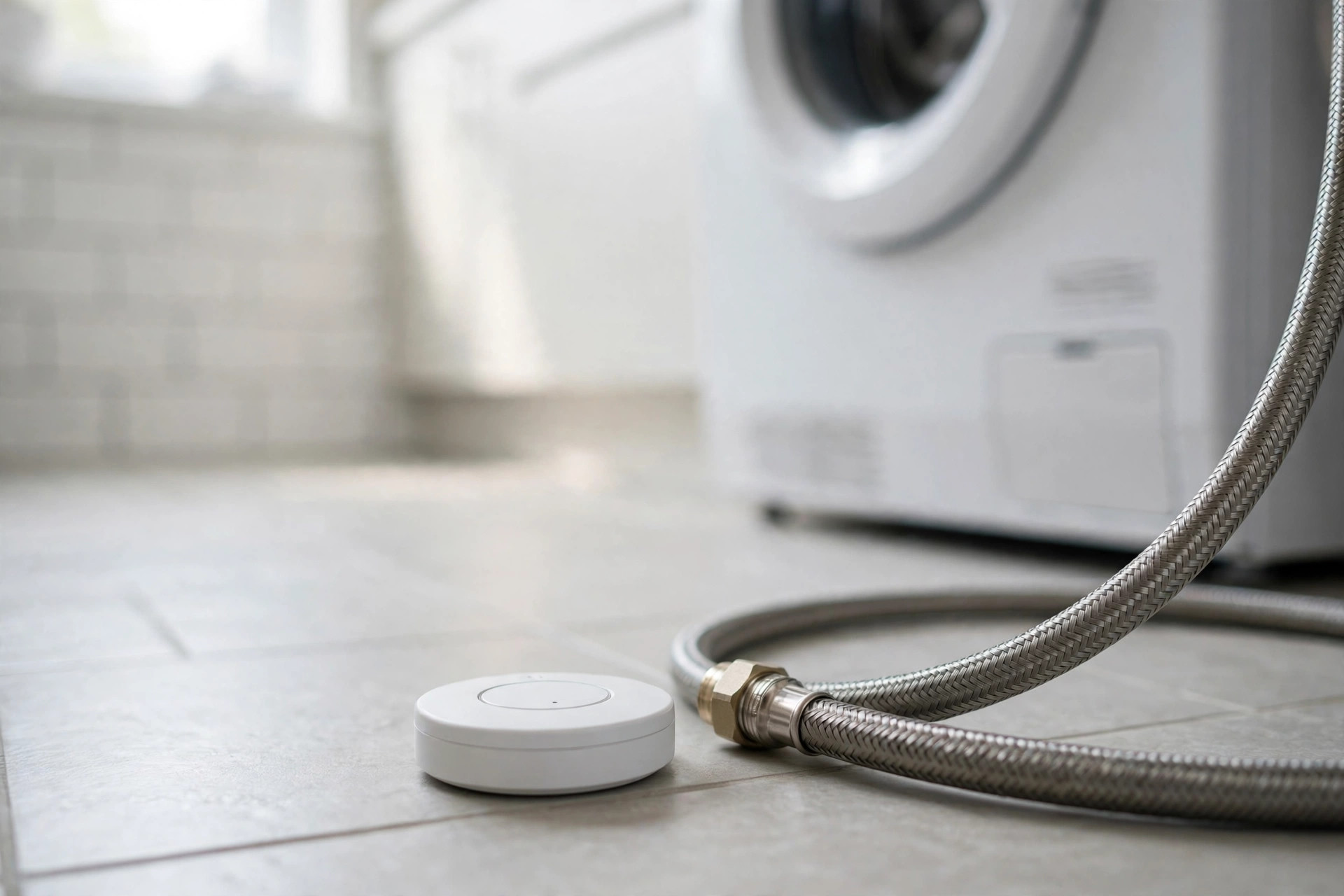
Water damage is the most common and most expensive homeowner insurance claim category in America — and most of it starts as a slow, silent drip nobody notices for weeks. A water leak detector is a small puck or probe, usually $15–$40 per sensor, that sits under your water heater, behind the washing machine, or beneath a sink and screams (or texts you) the moment it touches water. For a buyer about to take ownership of every pipe, valve, and appliance in a house, a handful of these sensors is one of the highest-return purchases you can make in the first week of ownership.
Why leak detectors belong on every buyer's move-in list
Here's the math that matters: the average water-damage insurance claim runs into the thousands of dollars, while a basic leak sensor costs less than a pizza. Slow leaks are the real enemy — a supply line weeping behind a washing machine, a water heater rusting through at the base, a refrigerator ice-maker line dripping into a wall cavity. These don't announce themselves. By the time you see the stain on the ceiling below, the framing has been wet for weeks and the mold clock is already running.
Detectors change the timeline. Instead of discovering a leak at the "why is the cabinet floor black" stage, you discover it at the "there are three drops on the sensor" stage — when the fix is a $15 supply line and a towel, not a remediation crew. For buyers specifically, there's a second angle: many insurers now offer discounts for homes with leak detection (and some policies increasingly expect it), so ask your agent whether a sensor system or an automatic shutoff valve earns you a premium break.
The honest limit: a detector only protects the spot it's sitting in. It won't find the pinhole leak inside a wall three rooms away. That's why placement strategy matters as much as the hardware — cover the high-risk points and you've covered the large majority of real-world failures.
The three types of leak detectors, honestly compared
Audible-alarm pucks are the simplest: a battery-powered disc with metal contacts on the bottom. Water bridges the contacts, the puck emits a piercing alarm (usually 85+ decibels). They're cheap ($10–$20 each), need no WiFi, and work forever on a coin cell — but they only help if someone is home to hear them. A burst pipe at 2 a.m. while you're asleep upstairs? The alarm helps. The same burst while you're on a week-long vacation? Useless.
WiFi/smart detectors add phone alerts: when water hits the contacts, the sensor pings your phone via your home WiFi, and many also sound a local alarm. This is the category most buyers should default to — the alert reaches you at work, on vacation, anywhere. Expect $25–$45 per sensor, plus the mild annoyance of onboarding each one to your WiFi network. Battery life runs 1–3 years depending on the model, and most send low-battery warnings.
Detectors with automatic shutoff are the premium tier: sensors around the house talk to a motorized valve on your main water line, and when any sensor gets wet, the valve closes — stopping the leak at the source even if you're on another continent. Systems run $400–$700 plus installation (the valve needs a plumber unless you're handy). This is the closest thing to a complete answer, and it's increasingly what insurers reward with real discounts.
Where to put them: the placement that covers 90% of failures
You don't need twenty sensors. Most residential water damage originates at a short list of failure points, and covering them takes six to eight sensors in a typical single-family home:
- Water heater: the #1 source — place a sensor at the base, especially on units over 8–10 years old. Heaters don't usually burst; they weep from the bottom seam for days first.
- Washing machine: behind or beside the machine, near the supply hoses. Burst washer hoses are the classic catastrophic leak — hundreds of gallons while you're at work.
- Kitchen sink cabinet and dishwasher: under the sink (supply lines, disposal, P-trap) and in front of the dishwasher (it leaks forward and down).
- Bathroom toilets and sinks: behind each toilet at the supply line, and inside each vanity cabinet.
- Refrigerator water line: behind the fridge if it has an ice maker or water dispenser.
- HVAC condensate line / drain pan: especially in attics, where a clogged condensate line drips straight through the ceiling.
- Sump pit area: if the house has a sump pump, a high-water sensor tells you the pump failed before the basement floods.
Place sensors flat on the floor with the contacts down, as close to the likely source as possible — water spreads outward and down, so low and close beats centered and convenient. Test each one with a damp finger when you install it.
The picks: best water leak detectors for homebuyers
We compared specs across the detector types buyers actually buy — alert method, battery life, sensor design, and cost per protected spot. Prices move; check current listings.
Best overall: WiFi smart leak detector
A WiFi smart water leak detector is the best default for a new homeowner: phone alerts anywhere, local alarm as backup, and battery life measured in years. Look for one with a loud onboard siren (85 dB+), low-battery notifications, and a sensor design that detects along its full base — not just a single point. Expect $25–$45 per sensor; a 3-pack covers the water heater, washer, and kitchen for most buyers' first weekend.
- Pros: alerts reach your phone anywhere — the only type that protects an empty house
- Pros: multi-year battery life with low-battery warnings; no hub required on most models
- Cons: depends on your home WiFi — a router outage during a storm is exactly when you might need it most
- Cons: onboarding multiple sensors to WiFi is mildly tedious
Best value multi-pack: 3-pack or 5-pack sensor set
A multi-pack water leak detector set drops the per-sensor cost dramatically — often under $15 per sensor for a 3-pack — which is what makes whole-house coverage realistic. Most multi-packs in this price range are audible-alarm pucks rather than WiFi units, so pair the strategy to the reality: use them in spots where someone is usually home to hear them (kitchen, laundry, bathrooms) and put your WiFi sensors at the water heater and anywhere remote.
- Pros: lowest cost per protected spot — full coverage for the price of one smart sensor
- Pros: no WiFi, no app, no accounts; batteries last years and replacement is trivial
- Cons: audible-only means no protection when the house is empty
- Cons: cheaper pucks sometimes have weaker alarms — check the decibel rating before buying
Best premium protection: leak detector with automatic shutoff valve
An automatic water shutoff valve system with leak sensors is the complete answer: wireless sensors around the house, and a motorized valve on the main line that closes the moment any sensor gets wet. It's the only option that stops damage while you're away rather than just telling you about it. Expect $400–$700 for the system plus plumber installation for the valve — and call your insurer before buying, because many carriers discount premiums for exactly this equipment.
- Pros: actually stops the leak, not just reports it — protection works while you're on vacation
- Pros: often earns a homeowners insurance discount that pays back part of the cost
- Cons: the highest upfront cost by far, plus professional installation for the valve
- Cons: a false trigger shuts off water to the whole house — placement and sensitivity tuning matter
Best budget: basic audible water alarm puck
A basic audible water leak alarm is the $10–$15 entry point: drop it under the sink, and if water touches it, it screams. No apps, no WiFi, no subscriptions — just a loud alarm and a battery that lasts for years. It's the right call for renters, for spots where you're home most of the time, and for buyers who want something in place on day one while they research a smarter system.
- Pros: cheapest protection available; zero setup beyond placing it on the floor
- Pros: no connectivity to fail — works through power and internet outages
- Cons: useless when nobody's home to hear it
- Cons: single-point detection; a leak a foot away may take a while to reach the contacts
After move-in: the 30-minute leak-defense routine
Detectors are half the battle; the other half is eliminating the most failure-prone parts before they fail. In your first month, do three cheap things: replace rubber washing-machine supply hoses with braided stainless steel lines ($15–$25 for the pair — burst rubber hoses are a top cause of catastrophic claims), check the water heater's age on its serial-number label and budget for replacement if it's past 10–12 years, and learn where your main water shutoff is — then make sure everyone in the household can find it in the dark. A detector tells you there's a leak; a shutoff you can reach in 60 seconds limits it to a mop-up instead of a claim.
Our verdict
For most buyers, the winning combination is WiFi smart sensors at the water heater, washing machine, and any spot far from daily foot traffic, plus a cheap multi-pack of audible pucks everywhere else — full coverage for well under $150. If the house is older, has a finished basement, or you'll travel often, price out an automatic shutoff valve system and get the insurance quote first; the premium discount sometimes makes the math surprisingly friendly. Whatever you choose, install them in the first week — leaks don't wait for you to finish unpacking. Pair them with a mold test kit if the inspection flagged moisture anywhere, and see home inspection 101 for the full picture of what to check before closing.
Frequently asked questions
Do water leak detectors need WiFi to work?
Only the smart ones. Basic audible pucks work with no connectivity at all — they just need a battery. WiFi models need your home network for phone alerts, but most still sound a local alarm if the network is down.
How long do the batteries last?
Typically 1–3 years for smart sensors and 3–5+ for simple audible pucks. Most smart models send low-battery push notifications; cheap pucks usually chirp like a smoke detector when the battery runs low. Test them yearly regardless.
Can a leak detector prevent mold?
Indirectly, yes — and that's a big part of their value. Mold needs sustained moisture; catching a leak in hours instead of weeks usually means the area dries before mold gets established. A detector plus fast action beats any mold test kit for prevention.
Will my insurance really give me a discount?
Many carriers offer 5–10% discounts for automatic shutoff systems, and some offer smaller breaks for smart sensors. It varies widely by carrier and state — call your agent with the specific product in mind before you buy, and get the discount confirmed in writing.
Where's the single most important place for one sensor?
The water heater, if you can only pick one spot. It's the most common source of significant residential water damage, it fails by slow weeping (which sensors catch perfectly), and it's often in a garage or utility closet nobody checks daily.